
Keep the bar in contact with the thighs. The latissimus dorsi pushes the bar back to the thighs.
*This and all other videos in this blog are from the Strength Training app. Expand your understanding of kinesiology and body movement. Try the Strength Training app Today!The rod placed on the back illustrates the importance of maintaining a straight back.
Throughout the exercise, keep the back in a neutral position.
In other words, even when we bend down, we will keep the same back position as when we are standing erect! In this position, the core muscles work together with the greatest efficacy and protect the spine.
In any other position, neuro-muscular coordination among the core muscles is impaired! In other words, the cables that hold the bridge are weakened, and in addition, the mechanical load on the vertebrae loses balance and creates undesirable focused pressure.
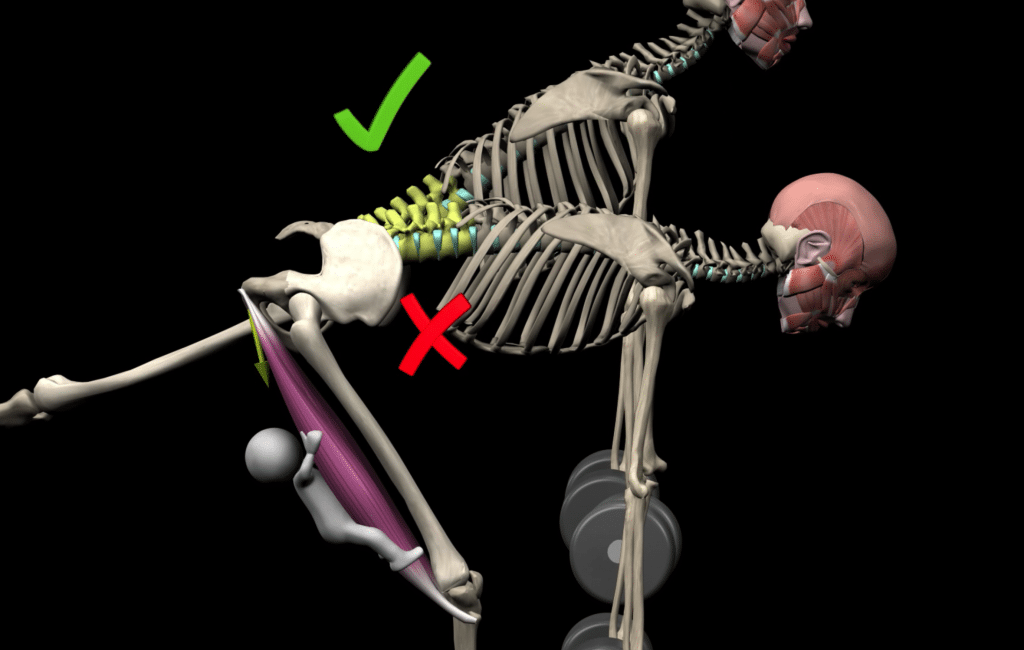
It is very common to see both sides of the spectrum when it comes to not having a neutral spine.
On the one hand, we have the athlete whose spine is in flexion (rounded). On the other hand, we have the athlete who overcompensates and pulls the lower lumbar into hyperextension, creating an extreme amount of tension and pressure on that area.
Another common mistake you should avoid is posterior pelvic tilt while raising the rod, which directly causes a chain reaction of flattening the lumbar lordosis, thus increasing the load on the lumbar vertebrae.Starts in a standing position. (the bar does not touch the floor). Classical Deadlift starts on the floor (Dead-stop).
Keep the back straight!
At the start, the bar should be resting against the thighs.
The movement is through the hip joint (hip hinge) and not through the spine.
Keep the bar in contact with the thighs all the way down.
Target muscles:
Gluteus maximus
Hamstrings
Erector spinae (static contraction)
The spinal erectors are statically active and prevent spinal flexion.
Take your stance, feet under the bar with a wide stance, and your toes out. Squat down and grasp the bar.
Squeeze the bar off the floor and drag it up your legs until it locks out at the top (do not pull back into the shins). The bar should come off the ground in a vertical path.
Keep these three rules:
1) The bar must start over mid-foot 2) The shoulders must start slightly in front of the bar 3) The hips must start relatively high