

Nerves are the body’s communication highways, carrying signals between the brain, spinal cord, muscles, and skin. They allow us to move, feel, and respond to our environment.
Among the major nerves of the upper limb, the radial nerve plays a central role. It travels a long course through the arm and forearm, providing both motor innervation to the extensor muscles and sensory supply to the posterior arm, forearm, and hand.
This detailed Muscle & Motion article will explore the radial nerve’s anatomical pathway, motor and sensory branches, and its essential role in upper limb function.
Pathway
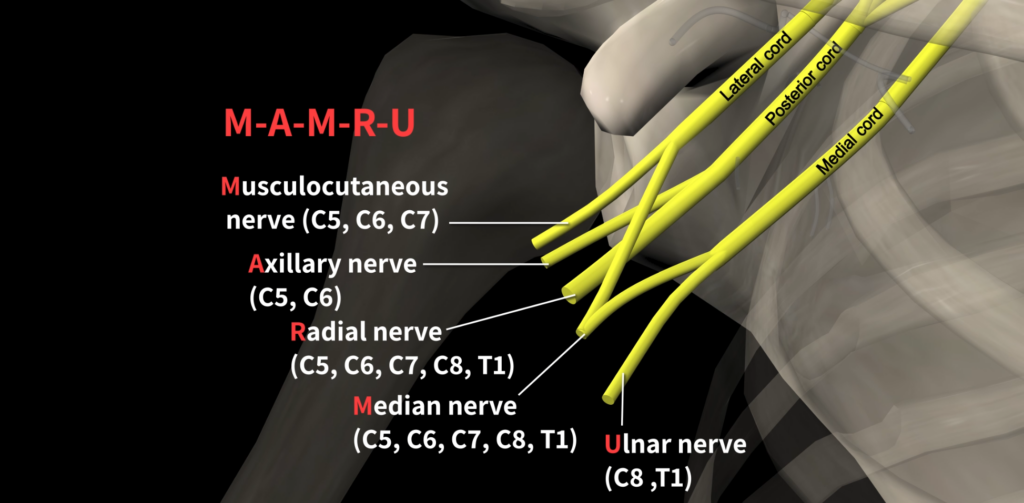
The radial nerve is one of the major terminal branches of the brachial plexus, a complex network of nerves formed by the anterior rami of spinal nerves C5–T1. The brachial plexus is the primary neural supply of the upper limb, organized into roots, trunks, divisions, and cords that ultimately give rise to its terminal branches.
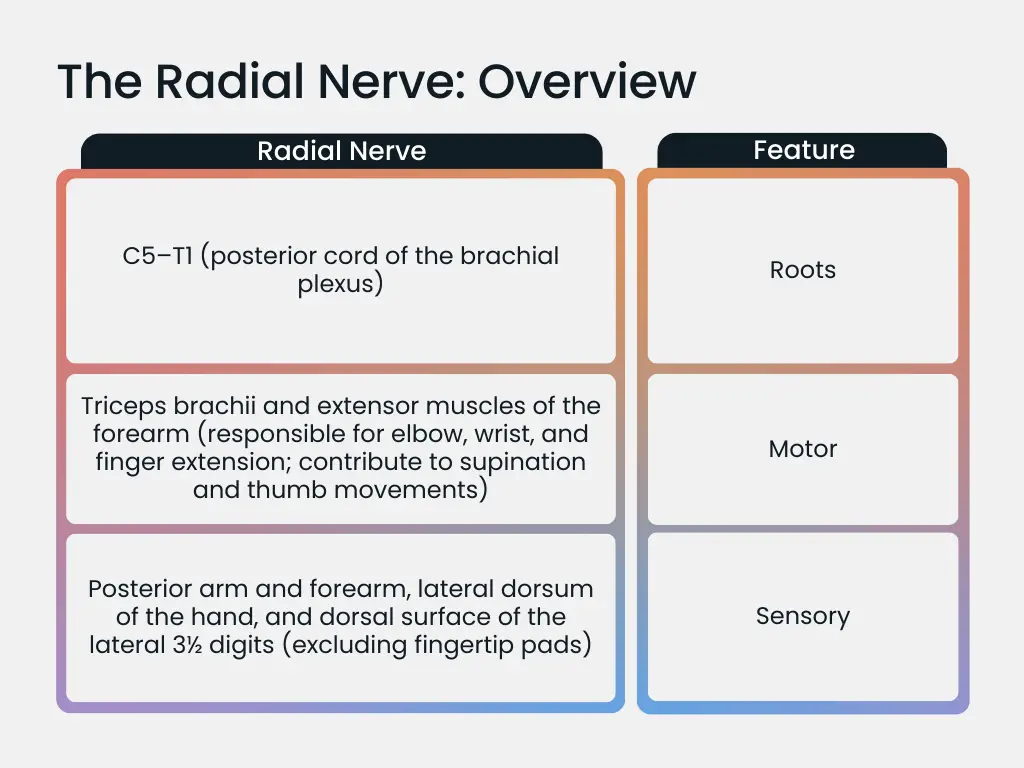
The radial nerve originates from the posterior cord of the brachial plexus, formed by the spinal nerves C5 to T1. It then passes posterior to the axillary artery. It enters the arm through the triangular interval, providing branches to the triceps brachii.
From there, it continues along the posterior aspect of the humerus in the radial groove, giving additional branches to the triceps and the anconeus muscle. At mid-arm, it pierces the lateral intermuscular septum to move into the anterior compartment, which courses between the brachialis and brachioradialis muscles.
At the level of the lateral epicondyle, the radial nerve divides into two branches:
- The deep branch, which passes through the supinator muscle and continues as the posterior interosseous nerve, innervates the extensor muscles of the forearm.
- The superficial branch runs beneath the brachioradialis and crosses the anatomical snuffbox to provide sensation to the dorsum of the hand.
Along its course, the radial nerve also gives off several sensory branches:
- The posterior cutaneous nerve of the arm arises in the axilla.
- The lower lateral cutaneous nerve of the arm branches off near the radial groove.
- The posterior cutaneous nerve of the forearm originates near the lateral epicondyle.
These branches supply the skin of the posterior arm, the posterior forearm, and the dorsum of the lateral hand.
Motor Functions
The radial nerve is the main extensor nerve of the upper limb, responsible for powering movements that straighten and stabilize the elbow, wrist, fingers, and thumb, as well as assisting in supination.
- Elbow extension: primarily by the triceps brachii and anconeus.
- Elbow flexion (in mid-pronation): by the brachioradialis.
- Supination of the forearm: via the supinator muscle.
- Wrist extension: performed by the extensor carpi radialis longus and brevis and the extensor carpi ulnaris.
- Finger extension: carried out by the extensor digitorum, extensor indicis, and extensor digiti minimi.
- Thumb movements:
Functional role: Together, these actions enable a powerful extension of the elbow, wrist, fingers, and thumb, while also supporting forearm rotation and maintaining grip stability.
💡 Did you know?
Because the radial nerve innervates the wrist extensors, this nerve is essential for extension and grip strength. By holding the wrist in slight extension, the extensors create the optimal position for the finger flexors to generate maximum force. Without this stabilization, the wrist tends to collapse into flexion during gripping tasks, leading to a significant drop in grip strength.[1-3]
Sensory Functions
In addition to its motor role, the radial nerve provides sensory innervation to the upper limb.
- Arm: via the posterior cutaneous nerve of the arm and the lower lateral cutaneous nerve of the arm, supplying the posterior and lateral upper arm.
- Forearm: through the posterior cutaneous nerve of the forearm, innervates the posterior surface of the forearm.
- Hand: the superficial branch of the radial nerve supplies sensation to the dorsum of the lateral hand and the dorsal surfaces of the lateral three and a half digits (thumb, index, middle, and radial half of the ring finger), except for the fingertips, which are supplied by the median nerve.
Functional role: This sensory distribution allows the radial nerve to provide feedback from the posterior arm, forearm, and dorsum of the hand, supporting coordinated movement and protective responses.
At Muscle and Motion, we believe that knowledge is power, and understanding the ‘why’ behind any exercise is essential for your long-term success.
Let the Strength Training App help you achieve your goals! Sign up for free.


Reference:
- Suzuki, T., Kunishi, T., Kakizaki, J., Iwakura, N., Takahashi, J., & Kuniyoshi, K. (2012). Wrist extension strength required for power grip: a study using a radial nerve block model. The Journal of Hand Surgery, European Volume, 37(5), 432–435. https://doi.org/10.1177/1753193411427831
- Shimose, R., Matsunaga, A., & Muro, M. (2011). Effect of submaximal isometric wrist extension training on grip strength. European Journal of Applied Physiology, 111(3), 557–565. https://doi.org/10.1007/s00421-010-1675-4
- Forman, D. A., Forman, G. N., & Holmes, M. W. R. (2021). Wrist extensor muscle activity is less task-dependent than wrist flexor muscle activity while simultaneously performing moderate-to-high handgrip and wrist forces. Ergonomics, 64(12), 1595–1605. https://doi.org/10.1080/00140139.2021.1934564
- Glover, N. M., Black, A. C., & Murphy, P. B. (2025). Anatomy, shoulder and upper limb, radial nerve. In StatPearls. StatPearls Publishing.

2 Responses
A really good blog and me back again.
Your enthusiasm for helping others is absolutely contagious and inspiring to all 🚀