

In the realm of resistance training, the way you focus during exercise is crucial. It’s not just about what exercises you do but also about how you execute them. You can use two key types of cues in your training: internal and external. Grasping the nuances between internal and external cues and their impact on your training regimen can be a significant tool in your arsenal, whether you’re a personal trainer or a therapist.
This understanding can enhance the effectiveness and precision of your training strategies. In this Muscle and Motion article, we will delve into the distinctions between internal and external cues and discuss practical ways to incorporate them into your training regimen.

Understanding internal and external focus
While positive thinking, motivation, and habit formation are essential for maintaining a consistent exercise routine and achieving results, muscle enhancement through mental focus is a unique aspect. It goes beyond general mindset or preparation for exercise; it’s about how thoughts can directly impact specific physical processes.
Defining attentional focus, aka cues
Mental focus, or cues, is essentially what an individual concentrates on during a specific activity.[1]
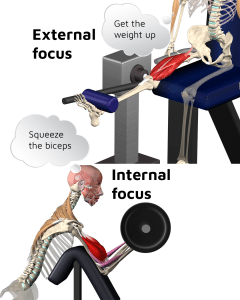
- Internal focus (cues): This involves focusing on the body’s movements and sensations during exercise. For instance, when performing biceps curls, you might instruct a trainee to “squeeze the biceps” or “feel the muscles contract,” emphasizing the mind-muscle connection.
- External focus (cues): Conversely, external cues shift the focus outward towards the environment or the outcome of the movement. Examples include instructing a trainee to “push the floor away” during a squat or to “get the weight up” during a machine leg extension. This external focus is more about the movement’s effect rather than the body’s internal sensations.[2]
Exploring the impact of mental focus on muscle development
Schoenfeld’s 2018 study on focus and muscle growth
In 2018, Brad Jon Schoenfeld and his team conducted a study published in the European Journal of Sport Science, exploring how mental focus affects muscle development in resistance training. The study involved 30 untrained men divided into two groups: one focused internally on muscle contractions (INTERNAL group), and the other focused externally on the lifting movements (EXTERNAL group).[2]
The study’s significant findings revealed that the INTERNAL group experienced a more substantial increase in muscle thickness (hypertrophy) in their elbow flexors (12.4%) compared to the EXTERNAL group (6.9%). However, both groups showed similar results in the growth of quadriceps muscles, with no significant difference between them. The researchers propose that this might be due to individuals generally having better control over their upper body muscles than their lower body muscles, indicating a variance in muscle control precision between the two areas.
This research underscores the effectiveness of the ‘mind-muscle connection’ in developing the elbow flexor muscles. It suggests that focusing on the muscles being worked can lead to more significant muscle growth in the upper body.
Let’s examine a meta-analysis to determine which type of focus – internal or external – is more effective for acute and long-term muscle strength gains.
Grgic et al.’s 2021 meta-analysis on focus and muscular strength
This meta-analysis by Grgic and colleagues examined the impact of internal versus external focus on muscular strength acutely and over the long term.
Key Findings:
- Acute Effects: An external focus led to a significant immediate increase in muscular strength.
- Long-Term Effects: No significant difference in strength gains between internal and external focus over the long term was found.
- Lower-Body Exercises: An external focus was found to be more beneficial for lower-body strength gains.
In summary, the meta-analysis suggests that adopting an external focus of attention can acutely increase muscular strength. Moreover, for long-term resistance training, particularly in lower-body exercises, an external focus of attention might be more beneficial for enhancing muscular strength gains compared to an internal focus.[3]
Maximizing athletic performance
Having discussed strength and hypertrophy, let’s shift our focus to athletic performance. Athletic performance primarily concerns the ability to execute movements with high precision. In this context, the emphasis is on enhancing motor learning, which is the process of refining and perfecting movement skills, rather than focusing on increasing muscle strength and size.
Research has shown that external cues are more effective than internal cues in enhancing athletic performance.
For instance, in sports like golf and volleyball, both beginners and advanced players have shown marked improvements in skill learning and retention when their attention is directed externally.[4] Similarly, world-class acrobats have demonstrated enhanced balance when they shift their focus away from their body movements to external cues.[5] This external orientation also extends to endurance exercises. Study participants have been able to sustain challenging positions like wall sits for longer durations, and they’ve reported a lower rate of perceived exertion, indicating a more efficient use of their physical capabilities.[6]
These varied examples across different athletic activities highlight the consistent benefits of an external focus, underscoring its role as a crucial element in optimizing athletic performance.

The theory behind the advantage of external focus over internal focus
The effectiveness of external cues is based on their influence on how we control our movements. When individuals concentrate on their own movements (internal focus) during a motor task, they tend to manage their actions in a more conscious and deliberate way. This approach can restrict the motor system and interfere with the body’s natural, automatic control mechanisms. On the other hand, focusing on the outcome of the movement, known as an external focus, encourages the use of these automatic processes, leading to more efficient and effective movement control.
In summary, understanding and applying internal and external focus nuances can significantly enhance resistance training and athletic performance, making it a vital component of any effective training regimen.
At Muscle and Motion, we believe that knowledge is power, and understanding the ‘why’ behind any exercise is essential for your long-term success. Our Strength Training App is a treasure trove of insights that assist in implementing an internal focus during your workouts. The app provides detailed visualizations showing muscle movements beneath the skin, making it simpler for you to understand and visualize the active muscles.
Let the Strength Training App help you achieve your goals! Sign up for free.
At Muscle and Motion, we believe that knowledge is power, and understanding the ‘why’ behind any exercise is essential for your long-term success.
Let the Strength Training App help you achieve your goals! Sign up for free.


Reference:
- Schoenfeld, B. J., & Contreras, B. (2016). Attentional focus for maximizing muscle development: The mind-muscle connection. Strength & Conditioning Journal, 38(1), 27-29.
- Schoenfeld, Brad Jon, Vigotsky, A., Contreras, B., Golden, S., Alto, A., Larson, R., Winkelman, N., & Paoli, A. (2018). Differential effects of attentional focus strategies during long-term resistance training. European Journal of Sport Science: EJSS: Official Journal of the European College of Sport Science, 18(5), 705–712.
- Grgic, J., Mikulic, I., & Mikulic, P. (2021). Acute and long-term effects of attentional focus strategies on muscular strength: A meta-analysis. Sports, 9(11), 153.
- Wulf, G., & Su, J. (2007). An external focus of attention enhances golf shot accuracy in beginners and experts. Research Quarterly for Exercise and Sport, 78(4), 384–389.
- Wulf, G. (2008). Attentional focus effects in balance acrobats. Research Quarterly for Exercise and Sport, 79(3), 319–325.
- Lohse, K. R., & Sherwood, D. E. (2011). Defining the focus of attention: Effects of attention on perceived exertion and fatigue. Frontiers in Psychology, 2.
