

“Keep your back flat! Protect your spine!” If you have ever set foot in a weight room or worked with a trainer, chances are this cue was drilled into you from day one. For decades, traditional lifting dogma has treated spinal flexion under load as a cardinal sin – an absolute shortcut to disc herniation and chronic back pain. Yet, if you watch high-level gymnasts, powerlifters, or functional movement practitioners, you will often witness them deliberately curling their spines through full flexion while holding heavy weights.
This glaring contradiction naturally sparks intense debate: is a rounded back truly an inevitable recipe for injury, or have we been overly dogmatic about back alignment all along? That debate got my colleagues and I thinking about a different question entirely. If you keep the weight on the bar the same, what changes for your muscles when you let your back round?
Wrestling With the Lifting Exercise Dilemma
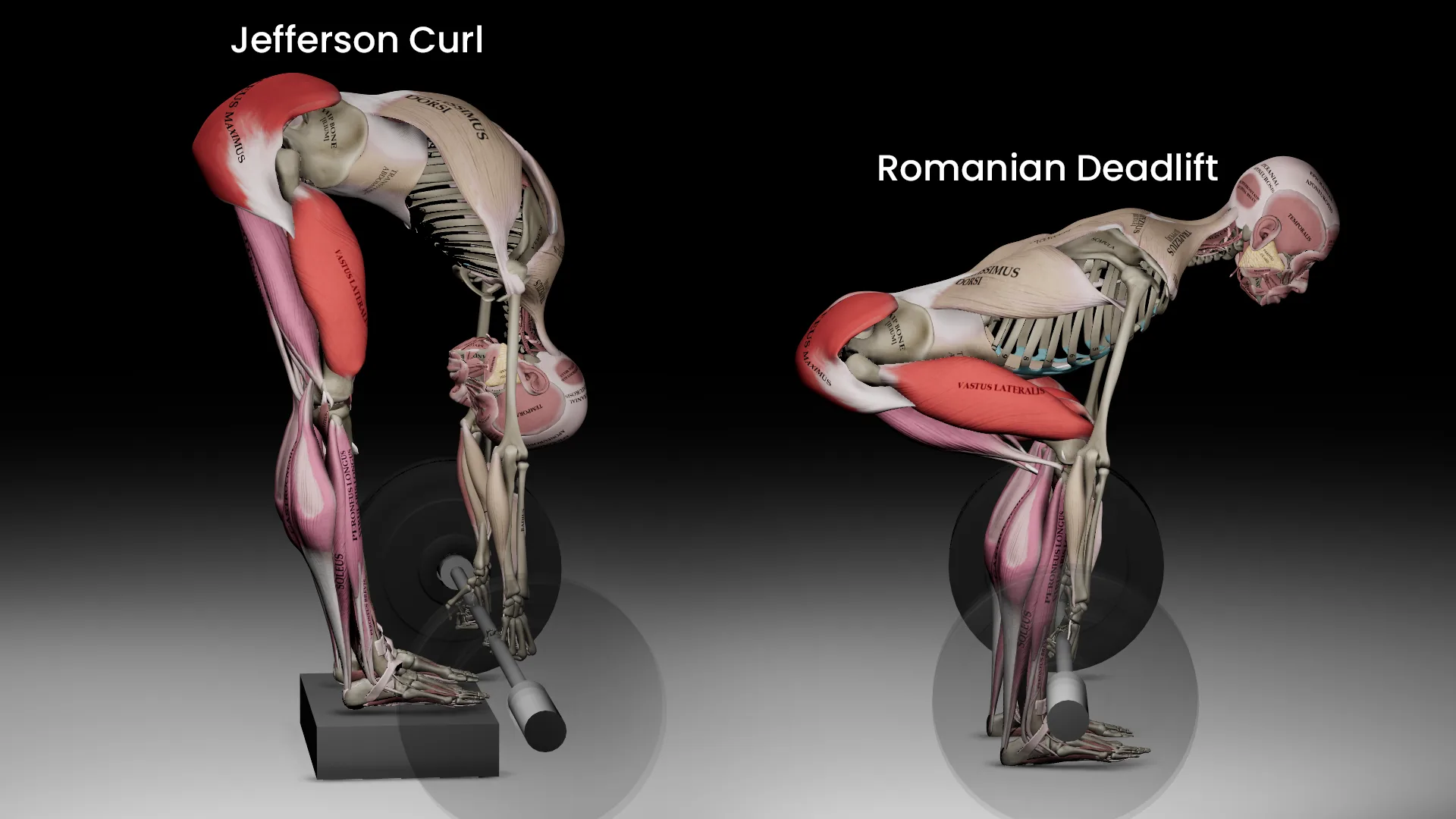
Picture two lifts. In a Romanian deadlift (RDL), you push your hips back and keep your spine relatively steady as the bar travels down your legs.
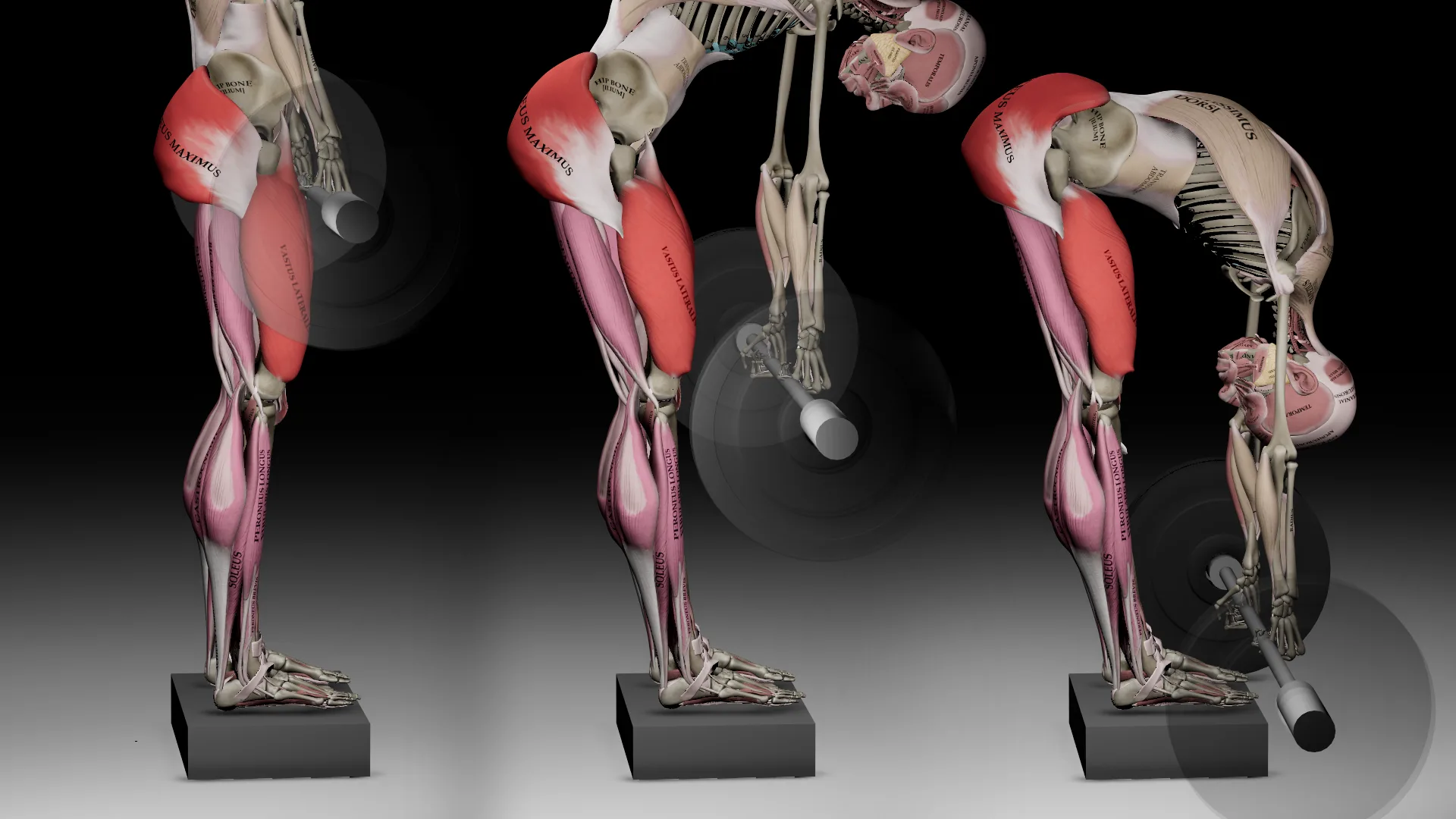
In a Jefferson curl, you gradually round your back as you lower the bar, then straighten it as you stand up. In both lifts, the bar travels toward the floor. What moves to get it there is different.
Surprisingly, despite the widespread popularity of both exercises, no scientific investigation had directly quantified and compared neuromuscular recruitment patterns between them under identical loading conditions. To address this, we recruited 21 experienced lifters to execute both movements under precise laboratory tracking.
What we eventually uncovered challenged several traditional assumptions: while glute engagement remained virtually identical between the two exercises, the upper back experienced significantly greater demand during segment-by-segment spinal flexion. [1]
Inside the Lab: How We Measured the Muscle Demands
To ensure accurate results, all 21 study participants were healthy, pain-free, and seasoned in barbell training. Each lifter performed five controlled repetitions of the Jefferson curl, followed by five repetitions of the RDL. Because the Jefferson curl is inherently more challenging due to its extended range of motion and segmental control requirements, we first established a demanding submaximal weight for it – averaging roughly 42 kg across the cohort – and matched that exact barbell mass for the subsequent RDL set. [1]
To capture real-time muscular activity, we also attached surface electromyography (EMG) sensors across five primary anatomical regions. Three sensors tracked the paraspinal musculature running along the upper, middle, and lower spine, while two additional sensors monitored the posterior chain – specifically targeting the gluteus maximus and the biceps femoris (a key hamstring muscle). These non-invasive sensors then recorded micro-electrical signals generated whenever muscle fibers depolarized and contracted under load. [1]
To make these raw electrical values meaningful across individuals, we normalized the data by measuring each participant’s maximum voluntary isometric contraction (MVIC) for each target muscle group during isolated baseline tests. Expressing movement data as a percentage of MVIC allows for a standardized comparison: for instance, a 63% EMG reading indicates that the muscle operated at roughly two-thirds of its absolute peak capacity during that rep, providing a clear baseline for evaluating workload comparisons between lifts. [1]
Where Did Muscle Activity Change the Most?
| Muscle Area Measured | Jefferson Curl | Romanian Deadlift |
|---|---|---|
| Upper back muscles along the spine | 63% | 45% |
| Lower back muscles along the spine | 60% | 48% |
| Biceps femoris, one of the hamstrings | 54% | 42% |
| Mid-back muscles along the spine | 52% | 56% |
| Gluteus maximus | 31% | 31% |
The data revealed significant differences in electrical recruitment between the two lifts. The most dramatic divergence occurred in the upper back (thoracic erectors), where muscular activation averaged 63% during the Jefferson curl compared to just 45% during the RDL. Similarly, the lower back spinal erectors and the biceps femoris displayed meaningfully higher activation during the Jefferson curl. Conversely, mid-back paraspinal activation and gluteus maximus involvement remained essentially equivalent between both movement patterns. [1]
Viewing these biomechanical patterns as a whole yields valuable insights into exercise selection. While both exercises engage the gluteus maximus at a moderate baseline (~31%), rounding the spine under load drastically elevates muscular activity in the upper and lower back erector spinae. This means that simply altering how you articulate your spine during a downward lift can dramatically reallocate tension across specific muscular regions. [1]
Why Your Back Muscles Might Respond Differently
Why do spinal muscles work so much harder during a Jefferson curl, you may ask?
The key lies in their functional roles across different movements. During a standard Romanian deadlift, the paraspinal muscles act primarily as isometric stabilizers, keeping the spine rigid while the hip joint handles the motion. In contrast, during a Jefferson curl, the spinal muscles actively lengthen and shorten to control segmental articulation, battling external forces throughout the entire movement pathway.
Biomechanical leverage also plays a pivotal role here. Just as holding a heavy box farther from your chest increases the physical effort required to support it, allowing your spine to round shifts the barbell slightly farther from the vertebral pivot points. This increases the internal moment arm, requiring the spinal erectors to work harder to maintain control against gravity. However, because our study directly recorded surface electrical activity rather than internal kinetic forces, the lever-arm mechanism remains an active hypothesis requiring further confirmation. [1]
Perceived exertion further highlights the physical demands of spinal flexion. Thus, even when loading identical weight, flexing the spine feels distinctly more strenuous. In fact, 18 of the 21 participants rated the Jefferson curl as noticeably more difficult than the RDL. Factors such as movement familiarity, fatigue order (since the Jefferson curl was performed first to calibrate the load), and the heightened focus required for segmental motion likely contributed to these elevated recruitment signals. [1]
What Does This Tell Us About Lifting With a Rounded Back?
These findings bring a fresh perspective to traditional lifting advice. Much of the long-standing prohibition against spinal flexion originated from early cadaveric studies and early in vivo intradiscal pressure research. In one classic 1990s experiment, a subject lifting a 20 kg crate exhibited lower lumbar disc pressure when bending at the knees with a flat back. However, in that test, keeping the back straight naturally pulled the heavy object closer to the center of mass – making it difficult to determine whether the pressure drop stemmed from the back angle or from the proximity of the load. [2, 4]
Additionally, a recent systematic review evaluated whether lifting with greater lumbar flexion directly correlates with an increased risk or prevalence of low back pain. The analysis revealed no consistent causal link between spinal flexion during lifting and back injuries, though the authors noted that the overall quality of the available evidence was relatively low and that it focused mostly on light working loads (under 12 kg). [3]
Our experimental data add a vital piece to this evolving discussion by mapping precise variations in muscular recruitment between two matched barbell movements. While higher EMG readings demonstrate greater muscle work, determining absolute injury risk or intervertebral shear forces will require prospective clinical trials specifically designed to track structural strain over time. [1]
Where Does Each Lift Fit in Your Training?
Ultimately, choosing between these two exercises depends on your specific training goals. The Romanian deadlift remains an exceptional foundational exercise for building raw posterior chain strength and practicing a rigid hip hinge under heavy loads. Conversely, the Jefferson curl serves as a targeted tool to cultivate deliberate, controlled spinal articulation and bolster tolerance to multi-segmental loading.
While often categorized purely as a mobility drill, the Jefferson curl clearly demands high active recruitment from the upper and lower back muscles. This means that integrating light-to-moderate Jefferson curls into a broader training plan may potentially help condition the paraspinal tissues through full range of motion. Whether progressive loading of this movement promotes long-term back resiliency and strength adaptation, however, remains an exciting question for future research. [1, 9]
At Muscle and Motion, we believe that knowledge is power, and understanding the ‘why’ behind any exercise is essential for your long-term success.
Let the Strength Training App help you achieve your goals! Sign up for free.


References
- Yona T, Kalifa B, Gildar S, Margi R, Har-Nir I, Fischer AG. Surface EMG characterization of the Jefferson curl at a submaximal load matched to the Romanian deadlift: a cross-sectional study in resistance-trained adults. Int J Sports Phys Ther. 2026;21(11):1100-16. doi:10.26603/001c.172559
- Wilke HJ, Neef P, Caimi M, Hoogland T, Claes LE. New in vivo measurements of pressures in the intervertebral disc in daily life. Spine. 1999;24(8):755-62. doi:10.1097/00007632-199904150-00005
- Saraceni N, Kent P, Ng L, Campbell A, Straker L, O’Sullivan P. To flex or not to flex? Is there a relationship between lumbar spine flexion during lifting and low back pain? A systematic review with meta-analysis. J Orthop Sports Phys Ther. 2020;50(3):121-30. doi:10.2519/jospt.2020.9218
- Dreischarf M, Rohlmann A, Graichen F, Bergmann G, Schmidt H. In vivo loads on a vertebral body replacement during different lifting techniques. J Biomech. 2016;49(6):890-5. doi:10.1016/j.jbiomech.2015.09.034
- Nolan D, O’Sullivan K, Stephenson J, O’Sullivan P, Lucock M. What do physiotherapists and manual handling advisors consider the safest lifting posture, and do back beliefs influence their choice? Musculoskelet Sci Pract. 2018;33:35-40. doi:10.1016/j.msksp.2017.10.010
- Knechtle D, Schmid S, Suter M, Riner F, Moschini G, Senteler M, et al. Fear-avoidance beliefs are associated with reduced lumbar spine flexion during object lifting in pain-free adults. Pain. 2021;162(6):1621-31. doi:10.1097/j.pain.0000000000002170
- von Arx M, Liechti M, Connolly L, Bangerter C, Meier ML, Schmid S. From stoop to squat: a comprehensive analysis of lumbar loading among different lifting styles. Front Bioeng Biotechnol. 2021;9:769117. doi:10.3389/fbioe.2021.769117
- van der Have A, Van Rossom S, Jonkers I. Squat lifting imposes higher peak joint and muscle loading compared to stoop lifting. Appl Sci. 2019;9(18):3794. doi:10.3390/app9183794
- Heneghan NR, Lokhaug SM, Tyros I, Longvastøl S, Rushton A. Clinical reasoning framework for thoracic spine exercise prescription in sport: a systematic review and narrative synthesis. BMJ Open Sport Exerc Med. 2020;6(1):e000713. doi:10.1136/bmjsem-2019-000713
- Wernli K, Smith A, Coll F, Campbell A, Kent P, O’Sullivan P. From protection to non-protection: a mixed methods study investigating movement, posture and recovery from disabling low back pain. Eur J Pain. 2022;26(10):2097-119. doi:10.1002/ejp.2022