Artificial intelligence has transformed the way we access information. Today, students, therapists, trainers, and clinicians can ask questions and receive answers within seconds. Need to know which muscles are involved in a shoulder press? Curious about the biomechanics of a squat? AI can explain almost instantly.
The speed is impressive. The problem is that confidence and accuracy are not the same thing.
In movement science, anatomy, and biomechanics, small errors can lead to major misunderstandings. A muscle attached to the wrong structure, an incorrect joint action, or a simplified explanation of movement mechanics may seem insignificant at first glance. But for healthcare professionals, coaches, and students, these details matter.
The Challenge with AI-Generated Anatomy
Modern AI systems are trained to generate plausible answers by learning from patterns in large datasets. They do not truly understand anatomy, biomechanics, or clinical reasoning.
As a result, AI-generated content can sometimes:
- Misidentify muscles or anatomical structures
- Oversimplify biomechanical concepts
- Present inaccurate visual representations
- Produce different answers to the same question
- Sounds authoritative despite being incorrect
This becomes even more apparent when AI attempts to create anatomical illustrations or movement analyses. A shoulder exercise, for example, may appear visually convincing while containing inaccurate muscle placement, missing stabilizers, or biomechanical actions that do not reflect how the body actually moves.
For a beginner, these errors can be difficult to detect. For an educator, therapist, or coach, they can become a source of misinformation.
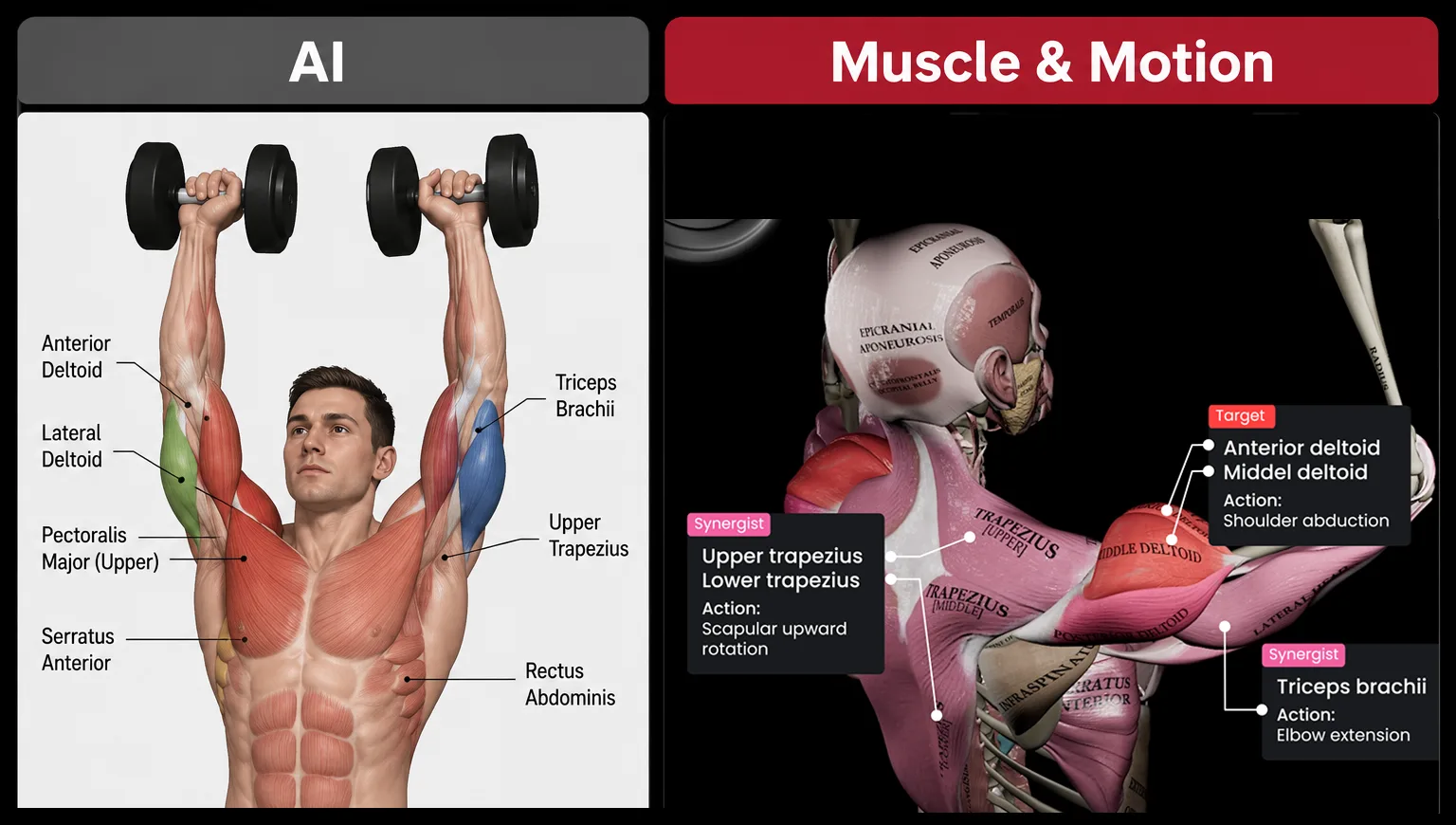
Understanding Movement Requires Visualization
Human movement is inherently visual. Reading about scapular upward rotation is not the same as seeing it, and reading about muscle function is not the same as watching movement unfold in three dimensions.
This is one of the greatest limitations of text-based AI. AI can describe movement, but Muscle & Motion allows learners to see movement.
Through interactive 3D models, biomechanical animations, and anatomical visualizations, learners can observe how muscles, joints, and movement patterns interact in real time. They can see which muscles act as prime movers, which muscles stabilize the movement, how forces are transferred through the kinetic chain, and how technique influences biomechanics.
Because movement is not just something we read about – it is something we see, analyze, and understand.
When the Question Shapes the Answer
Consider the following example.
A student asks:
“The athlete’s heels lift off the floor during a squat. Which muscle is tight?”
AI provides a detailed anatomical explanation:
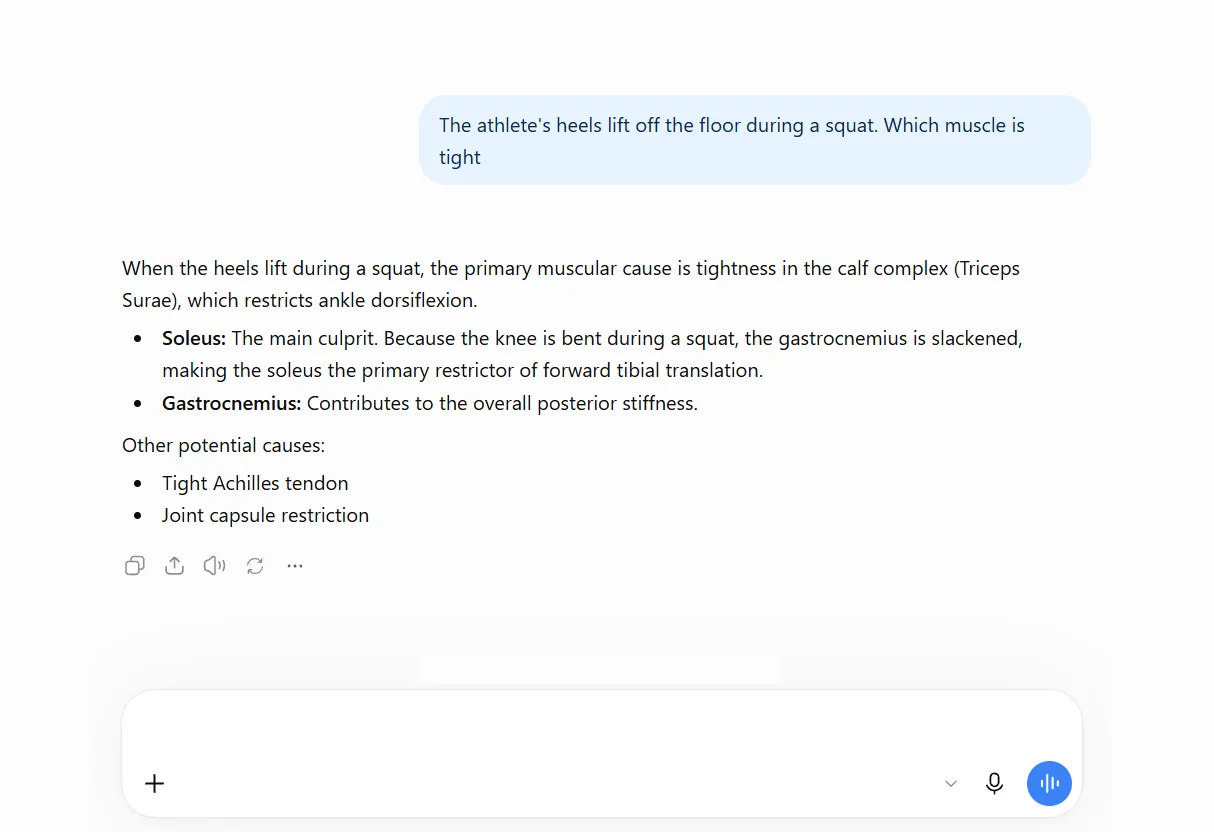
At first glance, the answer appears logical. The problem is that the question itself has already guided the answer.
By asking “Which muscle is tight?“, we have already assumed that a muscle restriction is responsible for the movement pattern. As a result, the AI naturally searches for muscles, tendons, and mobility limitations that could explain what it sees.
But what if the assumption is wrong? What if the athlete has normal ankle mobility? What if the movement is influenced by squat mechanics, stance width, bar position, balance, motor control, training experience, or individual anthropometric characteristics such as femur length and torso proportions?
In that case, the AI may provide a technically correct answer to the wrong question.
At Muscle & Motion, we take a different approach. Instead of starting with a predetermined explanation, we help learners understand the many factors that can influence movement. Through anatomy, biomechanics, movement analysis, and practical examples, users learn how to evaluate movement from multiple perspectives rather than searching for a single cause.
The goal is not to find an answer as quickly as possible. The goal is to understand whether you’re asking the right question in the first place.
AI is often guided by the assumptions built into the question. Muscle & Motion helps learners understand which assumptions to question.
The Difference Between Information and Understanding
AI is exceptionally good at answering questions. Ask which muscles are active during a shoulder press, and you’ll likely receive a reasonable answer.
But education requires more than answers.
A student may ask about the prime movers of an exercise, while missing the bigger picture – how the scapula moves, which muscles stabilize the joint, and how these concepts relate to performance, injury prevention, and rehabilitation.
The challenge is that learners often don’t know what they don’t know.
This is where Muscle & Motion takes a different approach.
Rather than providing isolated answers, we organize anatomy, biomechanics, and movement science into a structured learning experience that helps users connect concepts and understand how the body functions as a whole.
Because expertise isn’t built by collecting answers.
It’s built by understanding how the pieces fit together.
Why Movement Education Requires More Than a Prompt
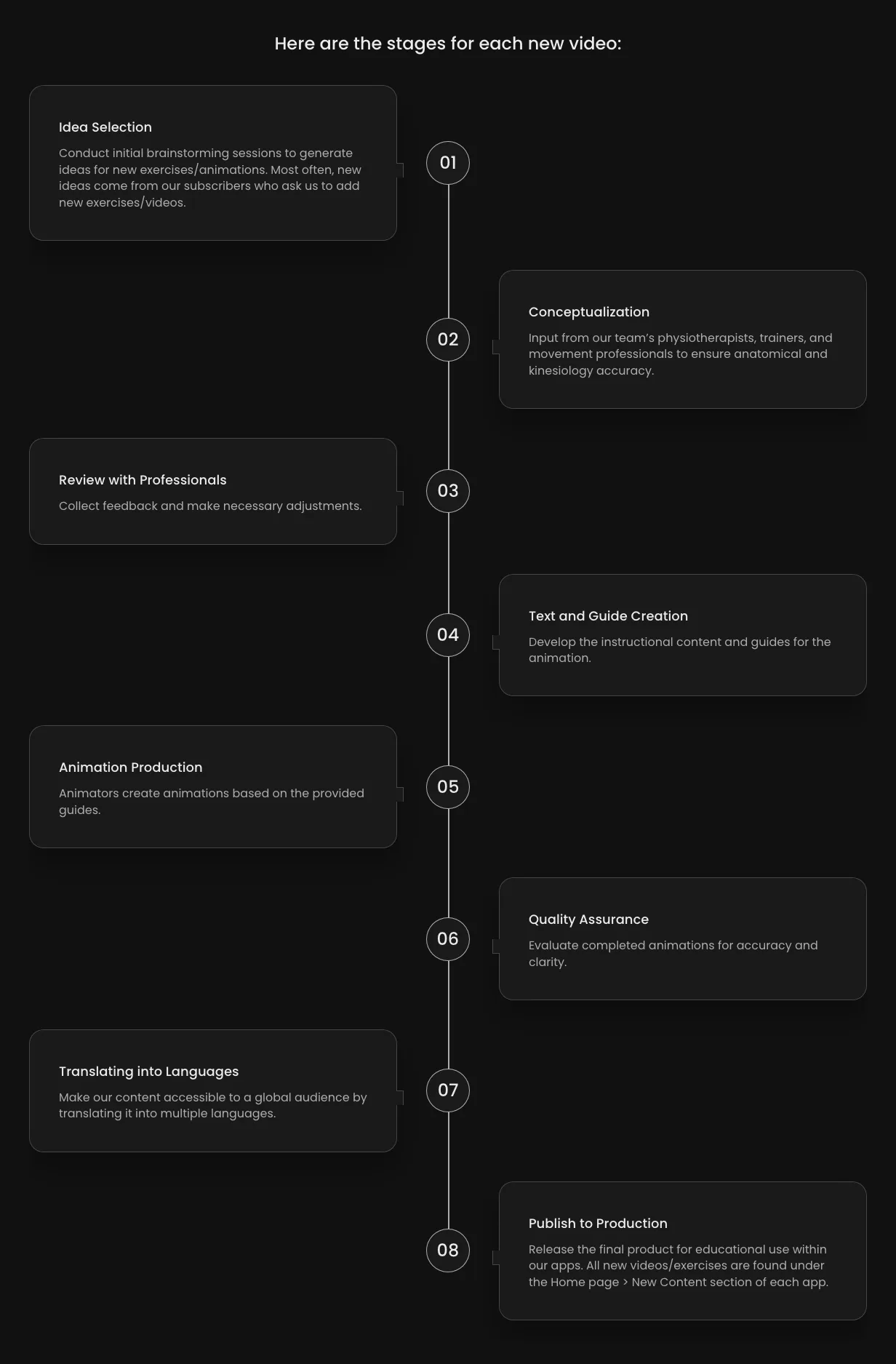
At Muscle & Motion, content is not generated in seconds. Every new exercise, animation, and educational video goes through a meticulous, collaborative development process to ensure the highest level of scientific accuracy and educational value.
Our team of physiotherapists, movement experts, educators, and animators works together through multiple stages of planning, review, production, and quality assurance. In some cases, it takes more than three months for a single illustration or exercise to reach publication.
The reason is simple: accuracy is not optional.
Every muscle, movement, biomechanical action, and educational element is carefully reviewed multiple times before being released to our global community of students, clinicians, coaches, and educators.
A Tool, Not a Replacement
None of this means AI has no role in education.
AI is a powerful tool for reviewing concepts, generating ideas, and answering questions. Many educators, coaches, and clinicians use it every day.
However, information alone does not create expertise.
The real challenge is learning how to interpret information, question assumptions, and apply knowledge in practice.
That’s where Muscle & Motion takes a different approach.
Rather than providing isolated answers, we help learners build a deeper understanding of anatomy, biomechanics, movement, rehabilitation, and performance through structured learning, expert-reviewed content, and interactive 3D visualization.
AI can answer questions.
Muscle & Motion helps learners understand movement.
The future of education will likely combine both. But when the goal is developing real expertise, understanding will always matter more than information.
Because professionals are not defined by the answers they memorize, they are defined by their ability to understand, analyze, and apply what they know.
At Muscle and Motion, we believe that knowledge is power, and understanding the ‘why’ behind any exercise is essential for your long-term success.
Let the Strength Training App help you achieve your goals! Sign up for free.