

Most athletes spend a lot of time thinking about training.
They carefully choose exercises, track their workouts, and look for ways to improve performance, build muscle, and stay injury-free.
But one of the most powerful performance tools often gets overlooked: sleep.
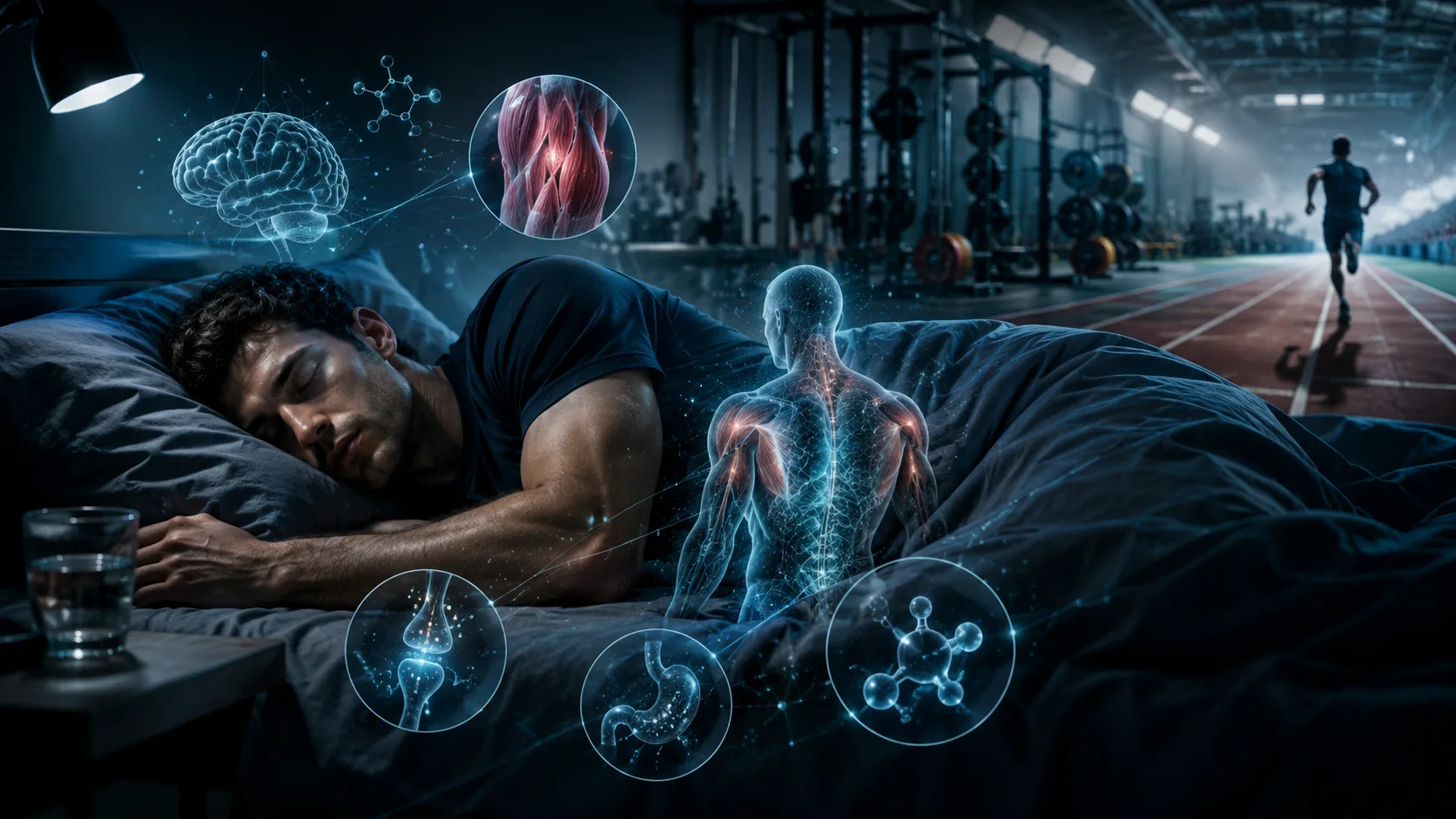
Many people think of sleep as passive rest. In reality, it is one of the most active periods of recovery in the entire training process. While you sleep, your body replenishes energy stores, repairs tissues, regulates hormones, strengthens neural pathways, and prepares for the next training session.
When sleep is compromised, those processes become less effective. Recovery slows down, fatigue accumulates, and performance begins to suffer.
In this Muscle & Motion blog, we’ll examine the scientific evidence behind sleep and athletic performance, exploring how sleep influences recovery, strength, endurance, cognitive function, and injury risk.
Reduced performance and faster fatigue
Sleep deprivation can affect multiple components of athletic performance. However, not all physical qualities respond in the same way.
Endurance
Endurance appears to be one of the most sleep-sensitive physical qualities. Research shows that insufficient sleep increases the physiological strain of exercise, resulting in higher heart rates, greater ventilatory demand, and an earlier onset of fatigue (Kaczmarek et al., 2025).
As a result, athletes often experience reduced aerobic capacity, shorter time to exhaustion, and a lower ability to sustain performance during prolonged exercise (Vitale et al., 2019; Walsh et al., 2021).
Sprint and high-Intensity
Sleep loss can also impair activities that require repeated high-intensity efforts.
Several studies have reported slower sprint times, reduced anaerobic power, and decreased peak force production following acute or prolonged sleep deprivation (Skein et al., 2011; Craven et al., 2022).
Although the magnitude of these effects varies across studies, the overall trend suggests that sleep deprivation can compromise an athlete’s ability to perform explosive efforts at a high level repeatedly.
Strength and power
The relationship between sleep and maximal strength is less clear.
Some studies have found little to no change in short-duration maximal efforts following acute sleep deprivation (Blumert et al., 2007), while others have reported reductions in maximal strength and peak force production (Reilly & Piercy, 1994).
Overall, the evidence suggests that maximal strength may be relatively resilient to short-term sleep loss, but longer or more severe sleep restriction is more likely to affect performance negatively.
Training quality and work capacity
The most consistent finding is not a reduction in peak performance, but a reduction in overall training quality.
Even when athletes can still produce a maximal effort, sleep deprivation often reduces their ability to maintain intensity, perform repeated efforts, tolerate higher training volumes, and sustain performance throughout an entire session (Walsh et al., 2021).
In practical terms, a poor night’s sleep may not prevent you from lifting a heavy weight once. It may, however, reduce the quality of the subsequent workout.
Sleep is when recovery happens
Training creates the stimulus. Recovery creates the adaptation.
During sleep, the body repairs damaged tissues, restores glycogen stores, regulates immune function, and supports muscle protein synthesis.
When sleep is restricted, recovery becomes less efficient.
Research has shown that even a single night of total sleep deprivation can increase cortisol levels, reduce testosterone levels, and decrease muscle protein synthesis rates (Kaczmarek et al., 2025).
These changes create a less favorable environment for muscle repair and growth. Sleep restriction may also increase inflammation and slow the recovery process between training sessions (Chennaoui et al., 2021).
For athletes, sleep is not time away from training. It is part of the training.
Performance is more than muscles
Athletic performance is not just about muscles.
Whether you are reacting to an opponent, adjusting your pace during a race, or performing a complex movement under pressure, your brain is constantly involved.
Sleep plays a key role in reaction time, attention, decision-making, motor learning, and skill acquisition (Vitale et al., 2019; Walsh et al., 2021).
When sleep is restricted, athletes tend to react more slowly, lose focus more easily, and make poorer decisions. Technical skills can suffer as well. Studies have reported declines in tennis serving accuracy and soccer kicking precision following inadequate sleep (Vitale et al., 2019).
The good news is that improvements in sleep can translate into improvements in performance.
In one study, basketball players who extended their sleep duration improved sprint performance and shooting accuracy by approximately 9% (Vitale et al., 2019; Walsh et al., 2021).
Sometimes the easiest performance enhancement is not a new training method. It is simply getting more sleep.
Why are tired athletes more likely to get injured
Sleep affects more than performance. It may also influence injury risk.
Think about what happens when you are sleep deprived. You react more slowly, lose concentration more easily, and struggle to maintain movement quality as fatigue builds.
Over time, those small changes can increase the likelihood of mistakes during training and competition.
Research consistently shows a connection between poor sleep and injury risk. Adolescent athletes who slept less than 8 hours per night were 70% more likely to sustain an injury than those who slept at least 8 hours (Milewski et al., 2014).
Similar findings have been reported among runners, endurance athletes, dancers, and collegiate athletes, in which both shorter sleep duration and poorer sleep quality were associated with a greater likelihood of injury (Dobrosielski et al., 2021; Goldberg et al., 2025; Messman et al., 2025).
Sleep disturbances have also been linked to a higher risk of concussion and longer recovery periods following injury (Walsh et al., 2021).
Of course, sleep is only one factor among many. However, the overall message is remarkably consistent:
Athletes who consistently sleep less tend to get injured more often.
Takeaway
Sleep is far more than a passive period of rest.
It is a biological process that supports recovery, muscle growth, hormonal regulation, cognitive performance, skill acquisition, and injury prevention.
While athletes often focus on training programs, nutrition strategies, and supplements, none of these interventions can fully compensate for chronic sleep deprivation.
The scientific evidence is clear: inadequate sleep can impair performance, slow recovery, increase fatigue, and elevate the risk of injury. Conversely, improving sleep may be one of the simplest and most effective ways to enhance athletic performance.
If you are looking for a competitive edge, the first place to start may not be the gym.
It may be your bedroom.
At Muscle and Motion, we believe that knowledge is power, and understanding the ‘why’ behind any exercise is essential for your long-term success.
Let the Strength Training App help you achieve your goals! Sign up for free.


References:
- Alhainen, M., et al. (2022). Sleep duration and the risk of occupational and commuting injuries.
- Blumert, P. A., Crum, A. J., Ernsting, M., Volek, J. S., Hollander, D. B., Haff, E. E., & Haff, G. G. (2007). The acute effects of twenty-four hours of sleep loss on the performance of national-caliber male collegiate weightlifters. Journal of Strength and Conditioning Research, 21(4), 1146–1154.
- Brotherton, E. J., et al. (2019). The effects of acute partial sleep deprivation on strength and power performance.
- Bulbulian, R., Heaney, J. H., Leake, C. N., & Sucec, A. A. (1996). The effect of sleep deprivation and exercise load on isokinetic leg strength and endurance. European Journal of Applied Physiology, 73(3–4), 273–277.
- Chennaoui, M., Arnal, P. J., Sauvet, F., & Léger, D. (2021). Sleep and exercise: A reciprocal issue? Sleep Medicine Reviews, 20, 59–72.
- Craven, J., et al. (2022). The effects of acute sleep deprivation on physical performance: A systematic review and meta-analysis.
- Dobrosielski, D. A., et al. (2021). Sleep, recovery, and injury risk in athletes: Current evidence and practical recommendations.
- Goldberg, A., et al. (2025). Sleep quality and injury risk among runners.
- Kaczmarek, M., et al. (2025). Effects of sleep deprivation on exercise performance, physiological responses, and muscle recovery.
- Messman, R., et al. (2025). Sleep disturbances and injury risk in collegiate athletes.
- Milewski, M. D., Skaggs, D. L., Bishop, G. A., Pace, J. L., Ibrahim, D. A., Wren, T. A. L., & Barzdukas, A. (2014). Chronic lack of sleep is associated with increased sports injuries in adolescent athletes. Journal of Pediatric Orthopaedics, 34(2), 129–133.
- Reilly, T., & Piercy, M. (1994). The effect of partial sleep deprivation on weight-lifting performance. Ergonomics, 37(1), 107–115.
- Skein, M., Duffield, R., Edge, J., Short, M. J., & Mündel, T. (2011). Intermittent-sprint performance and muscle glycogen after 30 hours of sleep deprivation. Medicine & Science in Sports & Exercise, 43(7), 1301–1311.
- Souissi, N., Sesboüé, B., Gauthier, A., Larue, J., & Davenne, D. (2003). Effects of one night of sleep deprivation on anaerobic performance the following day. European Journal of Applied Physiology, 89(3–4), 359–366.
- Souissi, N., et al. (2013). Time-of-day effects and sleep deprivation on anaerobic performance.
- Takeuchi, T., et al. (1985). Effects of prolonged sleep deprivation on physical performance.
- Vitale, K. C., Owens, R., Hopkins, S. R., & Malhotra, A. (2019). Sleep hygiene for optimizing recovery in athletes: Review and recommendations. International Journal of Sports Medicine, 40(8), 535–543.
- Walsh, N. P., Halson, S. L., Sargent, C., Roach, G. D., Nédélec, M., Gupta, L., Leeder, J., Fullagar, H. H. K., Coutts, A. J., Edwards, B. J., Pullinger, S. A., Robertson, C. M., Burniston, J. G., Lastella, M., Le Meur, Y., Hausswirth, C., Bender, A. M., Grandner, M. A., & Samuels, C. H. (2021). Sleep and the athlete: Narrative review and 2021 expert consensus recommendations. British Journal of Sports Medicine, 55(7), 356–368.