

Why can a powerlifter squat 300 kilograms yet find themselves out-jumped by an athlete half their size? The answer lies in the intricate interplay between the nervous system, muscle architecture, and the physics of the force-velocity relationship. In the world of strength and conditioning, the terms “strength” and “power” are often used interchangeably by the general public. However, for a professional athlete or a dedicated coach, they represent two distinct physiological phenomena.
Understanding these differences is not merely an academic exercise; it is the foundation of effective programming. To truly optimize human performance, we must dive deep into the physiology of maximal strength, the mechanics of explosive power, and the biological “spring” known as the stretch-shortening cycle (SSC).
1. Maximal strength: The engine of force
Maximal strength is defined as the greatest amount of force a muscle or group of muscles can produce when time is not a limiting factor. It is typically expressed during isometric contractions or when overcoming heavy external loads, such as a one-repetition maximum (1RM).
The physiology of the “heavy grind”
Producing maximal force is not instantaneous. In an isometric contraction, it takes approximately 0.3 to 0.5 seconds to reach peak force. In dynamic lifts like a heavy deadlift, the “grind” can last several seconds. This capacity is governed by two primary pillars: muscle structure and neural drive.
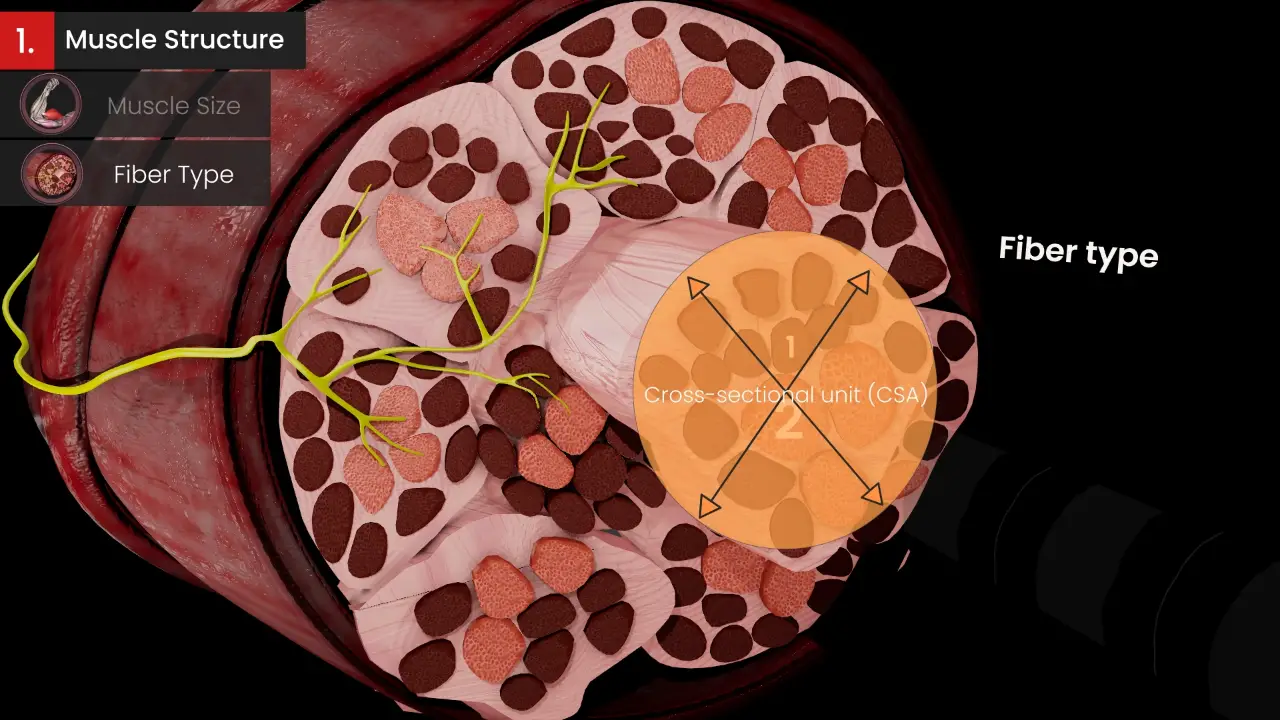
Muscle cross-sectional area (CSA):
From a structural standpoint, the strongest predictor of force is the muscle’s size. A larger cross-sectional area implies a greater number of sarcomeres – the functional units of muscle – working in parallel. Within these sarcomeres, the interaction between actin and myosin filaments creates “cross-bridges.” Slower contraction velocities allow more of these cross-bridges to remain attached simultaneously, resulting in higher total force.
Neural adaptations:
Strength is as much a neurological skill as a muscular one. To lift a maximal load, the brain must master:
- Motor unit recruitment: Activating the maximum number of motor units, particularly the high-threshold type ii (fast-twitch) fibers.
- Rate coding: Increasing the frequency of neural impulses to ensure the muscle fibers remain in a state of tetanus (maximal tension).
- Intramuscular coordination: The ability of different muscles to work together (synergy) while reducing the resistance from opposing muscles (antagonists).
To dive deeper into these mechanisms and master the science of force production, check out our full video on the Physiology of Maximal Strength.
2. Explosive power: The factor of time
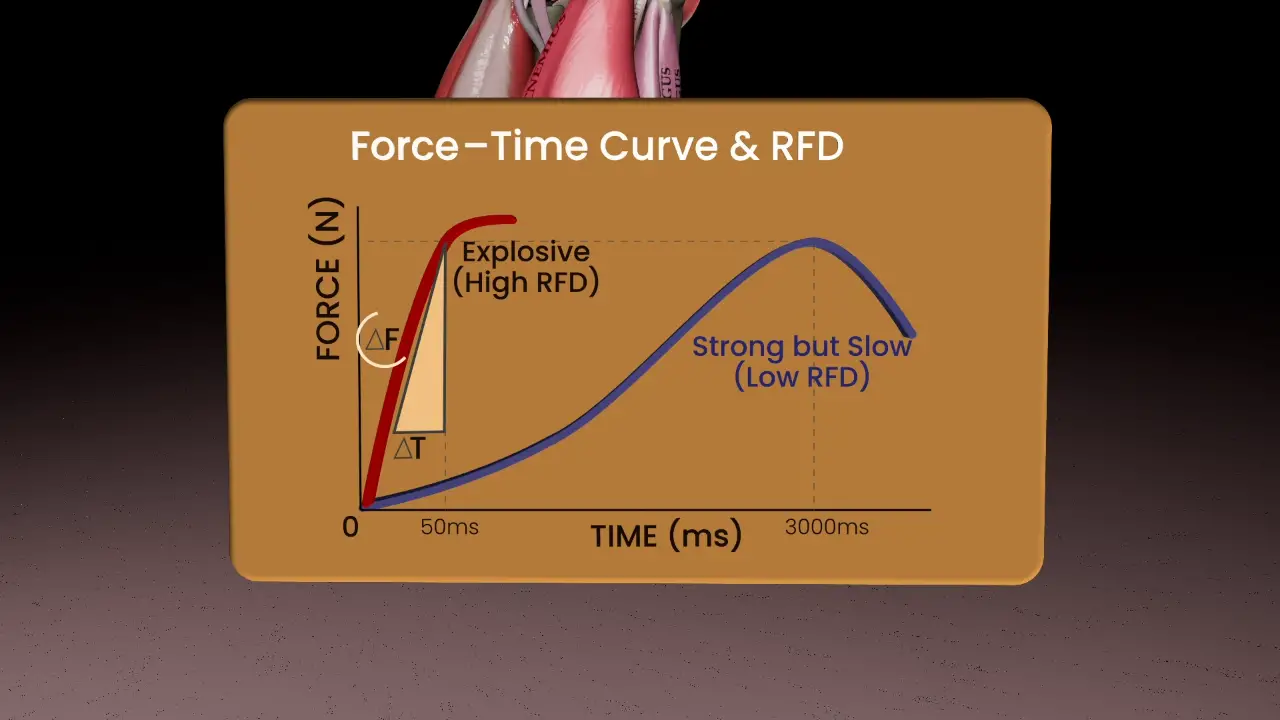
While maximal strength focuses on the quantity of force, explosive power focuses on the rate at which that force is applied. In physics, power is defined as force multiplied by velocity (P = F x v). In most sporting scenarios—jumping, sprinting, or throwing—the window to produce force is incredibly small, often less than 0.25 seconds. If an athlete has immense maximal strength but cannot “turn it on” quickly, that strength becomes useless in a high-velocity environment. This brings us to a critical metric: the Rate of Force Development (RFD).
The neural “sprint”
Explosive power is heavily dependent on the nervous system’s ability to produce a “high-frequency burst” at the onset of contraction. While a slow, heavy lift might involve neural firing rates of 30-60 Hz, an explosive movement can see firing rates exceeding 200 Hz within the first 50-75 milliseconds. Furthermore, Synchronization plays a vital role here. While asynchronous firing is efficient for maintaining steady force in a long lift, explosive power requires the motor units to fire all at once – a “power hit” that creates immediate acceleration. To learn more, watch our video on Explosive Power.
3. The force-velocity relationship: The great trade-off
To understand why we cannot lift a maximal weight quickly, we must look at the force-velocity curve. This curve visualizes the physiological trade-off: as the velocity of a contraction increases, the force it can produce decreases.
- The maximal strength zone: High force, low velocity (e.g., >80% 1rm squat).
- The power zone: The “sweet spot” where the combination of force and velocity yields the highest power output (typically 30-80% 1rm, depending on the exercise).
- The speed-strength zone: Moderate loads moved at high speeds (e.g., 30-60% 1rm).
- The maximal velocity zone: Very low force, maximal speed (e.g., sprinting or unweighted jumping).
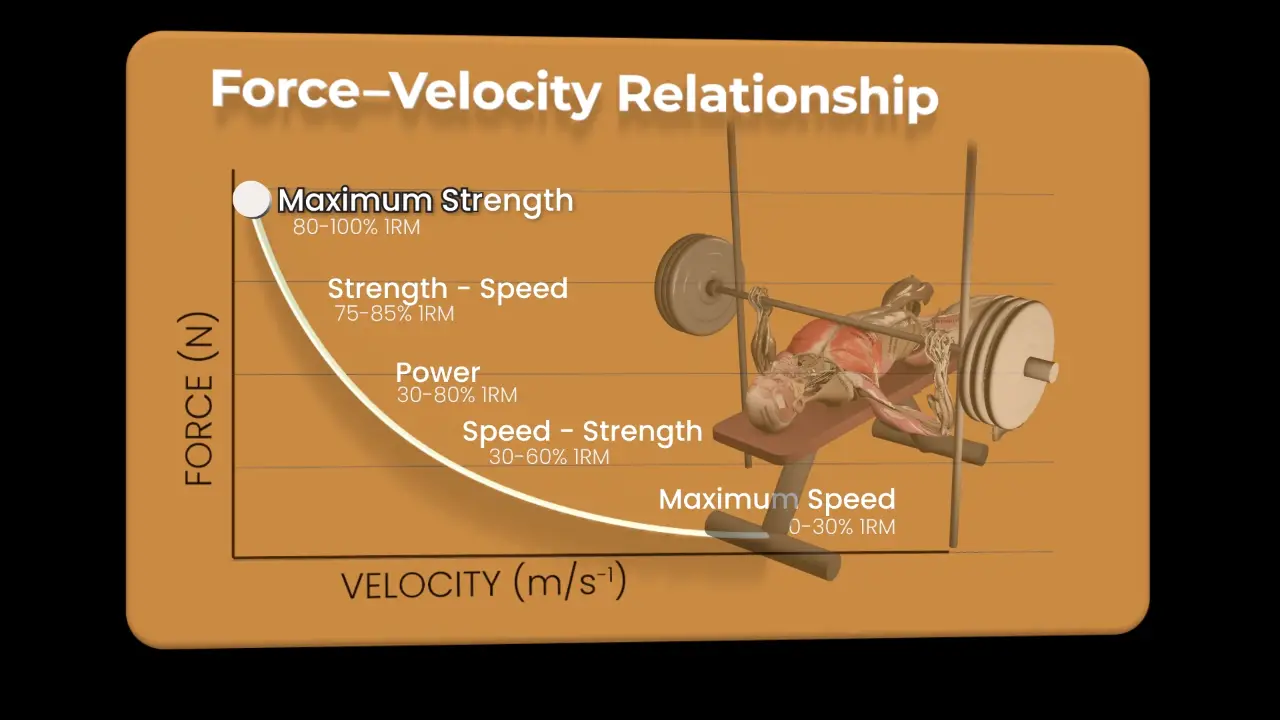
The goal of a comprehensive training program is to shift this entire curve to the right, allowing an athlete to produce more force at any given velocity.
4. The stretch-shortening cycle (SSC): The biological spring
The most potent expression of explosive power occurs through the stretch-shortening cycle. If you try to jump from the bottom of a squat (a “static start”), you will jump significantly lower than if you perform a quick “dip” before the jump. That dip is the SSC in action.
The three phases
- The eccentric phase: The rapid lengthening of the muscle-tendon unit. This “loads” the system.
- The amortization phase: The critical transition point. The shorter this phase, the more energy is preserved. If you pause at the bottom, the stored energy dissipates as heat.
- The concentric phase: The explosive shortening, fueled by both voluntary contraction and the release of stored elastic energy.
Where does the “free energy” come from?
The SSC effectiveness is rooted in two main mechanisms:
- Elastic energy: Tendons act like rubber bands. When stretched rapidly, they store potential energy that is “snapped” back during the concentric phase.
- The stretch reflex: Muscle spindles detect the rapid stretch and send an emergency signal to the spinal cord, causing a reflexive, involuntary contraction that adds to the voluntary effort.
To learn more, watch our video on the Stretch-Shortening Cycle
5. Fast vs. slow SSC: Specificity in training
Not all explosive movements are created equal. The literature distinguishes between:
- Fast SSC (<0.25s): Characterized by small joint ranges and very short ground contact times. Examples include sprinting and “Ankling” drills. These rely heavily on tendon stiffness and rapid recoil.
- Slow SSC (>0.25s): Involves larger joint excursions and longer durations. Examples include a countermovement jump or a basketball player loading up for a block. These rely more on “Active State” development – the time allowed for cross-bridges to form and build tension.
To learn more, watch our video on Plyometric Training.
6. Practical programming: From theory to the field
Understanding these concepts dictates how we should train. The factor of intent: You cannot “go through the motions” when training for power. Research shows that the intent to move a load as fast as possible is what drives the neural adaptations, even if the actual bar speed is slow due to a heavy load.
The rules of volume and fatigue: Power training is neural training, not metabolic conditioning. To improve RFD and SSC efficiency, the volume must remain low (3-6 reps) with full recovery (2-5 minutes) between sets. If fatigue sets in, speed drops, the amortization phase lengthens, and you are no longer training explosiveness – you are training endurance.
The hybrid approach: Maximal strength provides the “ceiling” for power. An athlete with a very low 1rm will eventually plateau in their power development because they lack the raw force to multiply by velocity. Therefore, strength and power training should be performed concurrently, moving from a foundation of maximal strength to a peak of explosive specificity.
In summary, maximal strength is about the “engine size” – the raw capacity to produce tension through muscle mass and motor unit recruitment. Explosive power is about the “tuning” – the ability of the nervous system to synchronize that tension in milliseconds and utilize the body’s elastic structures. By respecting the Force-Velocity Curve and the mechanics of the Stretch-Shortening Cycle, coaches and athletes can stop guessing and start building programs that turn heavy, slow strength into fluid, effortless, and devastating explosive power.
At Muscle and Motion, we believe that knowledge is power, and understanding the ‘why’ behind any exercise is essential for your long-term success.
Let the Strength Training App help you achieve your goals! Sign up for free.