

You can have the perfect volume, the ideal rep range, and a flawless program. You check every box on your spreadsheet, but the scale isn’t moving and your muscles aren’t growing. It is a frustrating plateau that many lifters hit. You are doing the work, so where are the results? The answer usually lies in the most overlooked piece of the hypertrophy puzzle: high effort.
In this Muscle & Motion article, we dive into the physiology of training intensity to bridge the gap between “doing the reps” and triggering real adaptation. Performing 3 sets of 10 and writing it down is just a start. If those sets do not reach a sufficient level of internal difficulty, your muscles have no biological reason to adapt. High effort is the internal signal – the physiological “SOS” – that tells your body it is time to build more tissue to survive the next bout of stress. Without it, you are simply going through the motions.
The science of recruitment: Henneman’s size principle
To understand why high effort is critical, we have to look at Henneman’s size principle. Your body is inherently efficient; when you begin a set, it recruits small, low-threshold motor units first, which control your Type I fibers. These fibers are endurance-oriented and have a limited capacity for significant growth. As the repetitions continue and fatigue builds up, the small motor units are no longer sufficient to produce the required force. To compensate, your brain progressively “calls in” more reinforcements, recruiting larger, high-threshold motor units that control Type II fibers.
It is important to understand that this is an additive process: your body doesn’t switch from small to large fibers; it accumulates them. By the end of a high-effort set, you are recruiting a much larger total number of fibers, with the high-growth Type II fibers finally being forced into action alongside the Type I fibers. For hypertrophy, this is the tipping point. If the set ends too early, you never reach that peak recruitment level, leaving the high-potential Type II fibers under-stimulated and missing the signal they need to trigger adaptation.
The weight-effort relationship
The necessity of reaching failure depends heavily on the load you are lifting:
- Light loads (15-30 reps): Because the weight is light, your body primarily uses only low-threshold units. You must train very close to failure – to accumulate enough fatigue to force the Type II fibers to activate.
- Moderate to heavy loads (1-10 reps): The high force demand requires Type II fibers from the very first reps. Because they are recruited earlier due to the weight, you can achieve a massive growth stimulus by training near failure without necessarily hitting total collapse every time.
Defining the finish line: technical vs. muscular failure
Before you push your limits, you must define where the “limit” actually is. Many lifters confuse a loss of focus or psychological discomfort with actual physical failure.
- Technical failure: This is the point where your form breaks. Think of excessive lower back arching during a shoulder press or using momentum to swing a curl.
- Muscular failure: This is the point where the muscle simply has nothing left – the weight will not move despite your maximum effort.
For hypertrophy, muscular failure is the goal. However, it is important to understand that technical failure is not “bad” – it is context-dependent. If your goal is purely to move the heaviest weight possible, you might intentionally use “cheat” form to complete a rep. But for muscle growth, maintaining technique ensures the tension stays on the target muscle. In the world of hypertrophy, when your technique fails, the set is effectively over.
Identifying intensity vs. effort
To master your training, you must distinguish between intensity and effort. These terms are often used interchangeably, but they serve different purposes.
- Intensity is your objective plan on paper. It is represented by your repetition maximum or RM. If your program says 10 reps, that is your target intensity.
- Effort is how you adjust for the fact that your body is not a machine. Your objective strength fluctuates daily. If you did not sleep well or are under high stress, your 10RM today will likely be lower than it was last week.
To ensure your training program is dynamic and accounts for daily fluctuations, we use autoregulation. This allows us to adjust the intensity based on your actual effort and readiness using three primary tools. We have two subjective measures, Rate of Perceived Exertion (RPE) and Reps in Reserve (RIR), and one objective method known as Velocity-Based Training (VBT). Here is a breakdown of how these tools work, their pros and cons, and who they are best suited for.
Reps in Reserve (RIR)
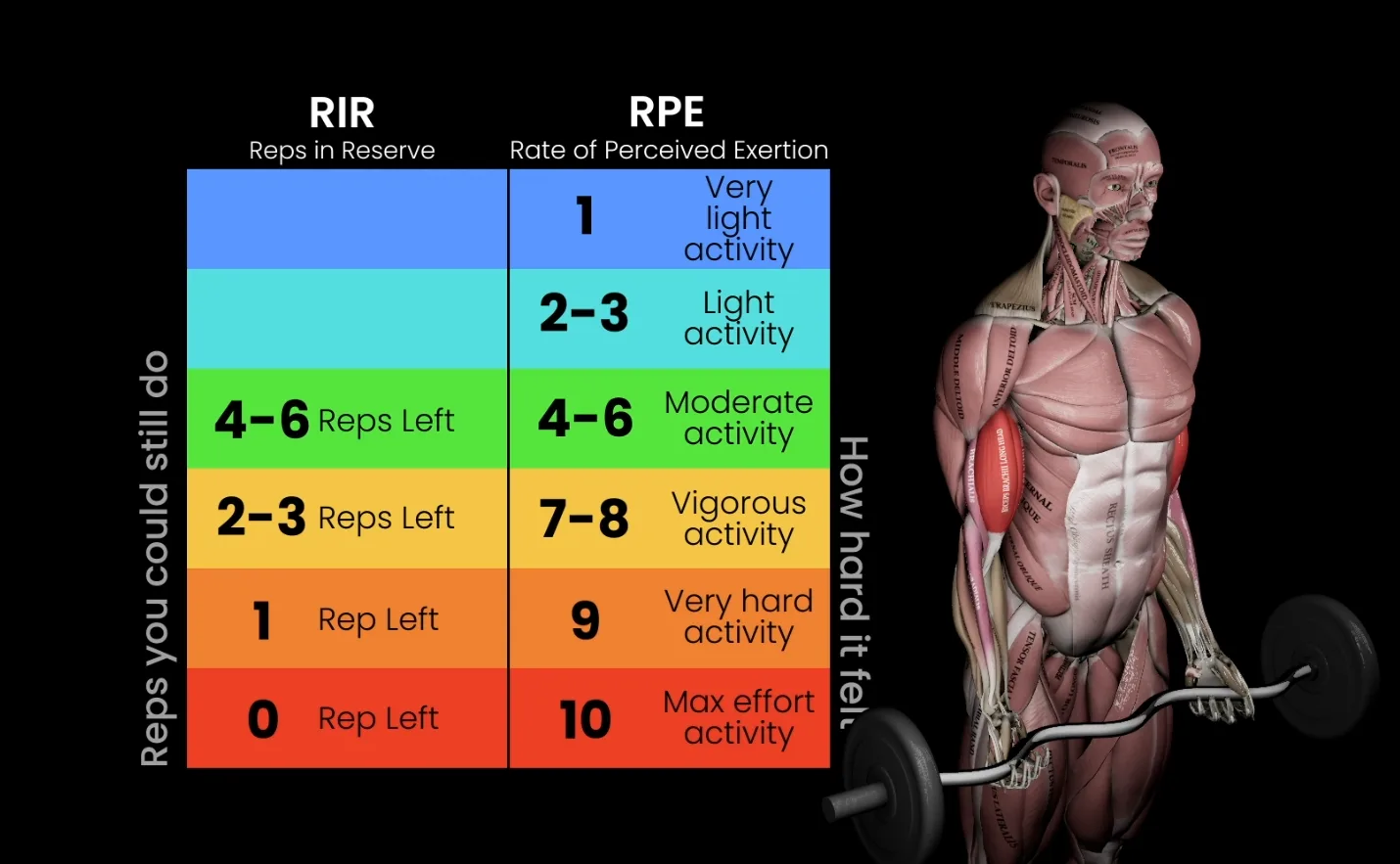
This metric measures how many more repetitions you could have performed with perfect technique before reaching failure. In practice, if you finish a set of 10 but estimate that you could have done exactly two more, you are at an RIR 2. If you push until no further reps are possible, your RIR is 0. Training within a 1 to 3 RIR range is the “sweet spot” for hypertrophy.
It provides a sufficient stimulus for growth without causing the excessive central nervous system fatigue associated with absolute failure, allowing for higher volume and better recovery over time. The primary limitation here is subjectivity. Research indicates that many lifters tend to underestimate their effort, leading to undertraining. To implement this effectively, you must “calibrate” your internal scale by occasionally performing sets to absolute failure on safe exercises. You cannot accurately measure the distance to the finish line if you have never actually crossed it.
Rate of Perceived Exertion (RPE)
This is a numerical scale from 1 to 10 that quantifies the overall difficulty of a set. In modern strength training, this tool is linked directly to your RIR: as the RPE increases, the number of remaining repetitions decreases.
- RPE 10: maximum effort (RIR 0). No further repetitions could have been performed.
- RPE 9: near-maximal effort (RIR 1). Only one repetition was left in the tank; bar speed slows significantly, and the set feels extremely demanding.
- RPE 7–8: challenging but controlled effort (RIR 2–3). The set feels demanding, but bar speed remains relatively stable and technique is easily maintained.
- RPE 4–6: moderate effort, leaving approximately 4 to 6 repetitions in reserve.
- RPE 1–3: very light effort, typically used for warm-ups or active recovery.
The main challenge with RPE is distinguishing true physical exertion from psychological discomfort. Factors like mood, sleep, or distractions can skew your ratings, which is why it is helpful to cross-reference this feeling with objective data.
The ultimate lie detector: Velocity-Based Training (VBT)
How do you know you are not lying to yourself about your effort? Watch the velocity. This is a physiological certainty: as you approach true failure, bar velocity must slow down involuntarily. This happens regardless of how much mental effort you apply. If your last rep moves as fast as your first, your effort simply isn’t high enough to recruit the high-threshold motor units required for optimal growth. While RPE and RIR are powerful, they rely on your perception. Velocity-Based Training (VBT) represents the objective anchor of modern training, moving us from estimation to real-time data by tracking movement speed in meters per second (m/s). It serves as the practical application of the “lie detector” principle, offering several key advantages:
- Real-time auto-regulation: your readiness can fluctuate by up to 18% daily. VBT acts as a monitor; if the bar moves faster than expected, you add weight. If it is slow, you decrease the load to match your physiological state for that specific day.
- Predicting the 1RM: because the relationship between load and speed is linear, we can calculate your one-repetition maximum (1RM) using submaximal loads, avoiding the systemic tax of a true max effort.
- Targeting specific zones: rather than guessing, we use exact speeds to target different traits. High velocities (1.0–1.3 m/s) define the speed-strength zone, while low velocities (under 0.5 m/s) indicate maximal strength.
- Managing fatigue: by setting a “velocity drop-off” threshold (e.g., 30%), you can terminate a set the moment quality declines. This ensures high-intensity intent and prevents “junk volume” that hinders recovery.
The primary limitation of VBT is the requirement for specialized technology. However, for those looking to eliminate guesswork, it provides the objective truth that your mind might try to ignore. If the bar isn’t grinding to a slow crawl by the end of a hard set, you haven’t reached the growth threshold.
In summary, building muscle isn’t about checking boxes on a program – it’s about the quality of the stimulus you provide. To maximize your results, you must ensure that your level of effort consistently matches your target intensity. Stop just counting the reps, and start making the reps count. Use tools like RPE and RIR to stay honest with your body, and when possible, use bar speed to ensure you are hitting the growth threshold every single time.
At Muscle and Motion, we believe that knowledge is power, and understanding the ‘why’ behind any exercise is essential for your long-term success.
Let the Strength Training App help you achieve your goals! Sign up for free.


References:
- Zhang, X., Feng, S., Peng, R., & Li, H. (2022). The role of velocity-based training (VBT) in enhancing athletic performance in trained individuals: A meta-analysis of controlled trials. International Journal of Environmental Research and Public Health, 19(15), 9252. https://doi.org/10.3390/ijerph19159252
- Helms, E. R., Cronin, J., Storey, A., & Zourdos, M. C. (2016). Application of the repetitions in reserve-based rating of perceived exertion scale for resistance training. Strength and Conditioning Journal, 38(4), 42–49. https://doi.org/10.1519/SSC.0000000000000218
- Morishita, S., Tsubaki, A., Takabayashi, T., & Fu, J. B. (2018). Relationship between the rating of perceived exertion scale and the load intensity of resistance training. Strength and Conditioning Journal, 40(2), 94–109. https://doi.org/10.1519/SSC.0000000000000373